Capture valuable content and expertise from Microsoft 365 and connected workflows with minimal disruption to employees.
/Infographics/AtlasFuse%20Explaination%20Diagram%20-%20Generic.png?width=2268&height=2100&name=AtlasFuse%20Explaination%20Diagram%20-%20Generic.png)
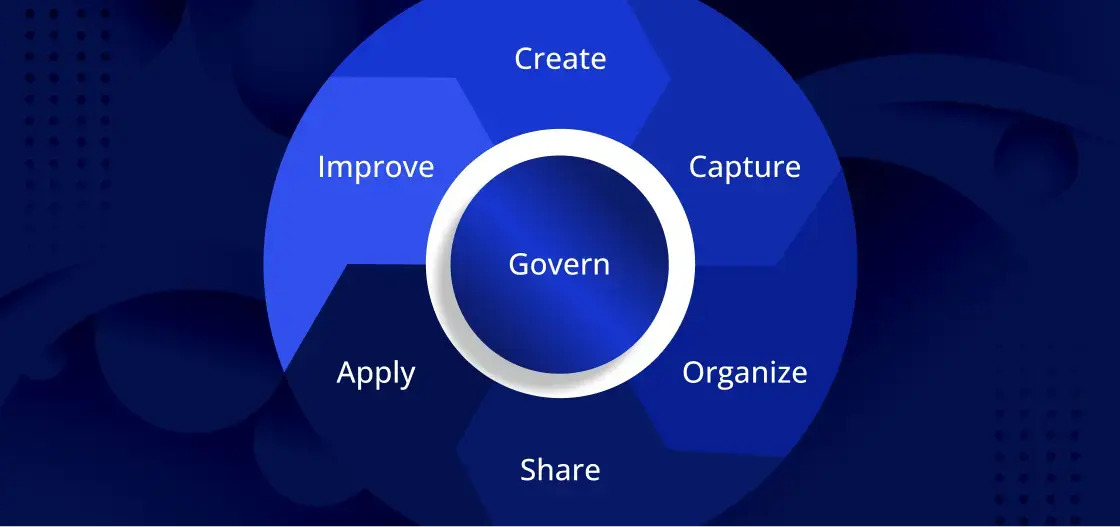
Operationalize the complete knowledge lifecycle
Keep enterprise knowledge accurate, current, governed, and reusable.
Knowledge loses value when it is difficult to capture, poorly structured, out of date, or disconnected from the work it supports. AtlasFuse helps organizations manage knowledge from creation and contribution through validation, contextualization, reuse, review, and retirement.
By embedding intelligent lifecycle services into Microsoft 365 and everyday workflows, AtlasFuse makes it easier for employees to contribute knowledge while giving owners and governance teams clear control over quality, relevance, permissions, and status.
Core capabilities
Knowledge capture
Classification and metadata
Apply structured metadata, taxonomy, and contextual classification to improve findability and reuse.
Validation and ownership
Assign subject matter owners, approval workflows, authoritative status, and review responsibilities.
Contextualization and enrichment
Connect knowledge to topics, clients, projects, products, processes, people, and related content.
Review and retirement
Automate review cycles, expiry, archival, and retirement so outdated knowledge does not remain active indefinitely.
Lifecycle insight
Track contribution, ownership, quality, usage, gaps, and lifecycle status through reporting and analytics.
/Illustrations/AtlasFuse%20in%20layers%20mini.png?width=1278&height=770&name=AtlasFuse%20in%20layers%20mini.png)
Why knowledge becomes fragmented and unreliable
In many organizations, knowledge management depends on manual publishing, inconsistent metadata, and periodic clean-up projects. Valuable work product remains hidden in email, Teams, project spaces, and individual repositories, while published knowledge becomes stale because ownership and review processes are unclear.
This weakens search, increases duplication, and reduces confidence in AI. Organizations need lifecycle management that operates continuously rather than as a separate administrative exercise.
How AtlasFuse helps
AtlasFuse captures knowledge in the flow of work and applies metadata, classification, ownership, validation, and lifecycle rules. Knowledge can be enriched with business context, linked to related experts and content, promoted into authoritative collections, and surfaced through search, portals, intranets, and AI.
Automated review and retirement processes help prevent outdated knowledge from remaining authoritative indefinitely. Reporting gives teams visibility into ownership, quality, usage, lifecycle status, and knowledge gaps.
Business outcomes
Trusted enterprise knowledge
More current, authoritative, and reusable enterprise knowledge.
Reduced administrative effort
Less manual effort for contributors, owners, and knowledge teams.
Lower content risk
Reduced duplication and lower risk from outdated content.
Better search & AI results
Improved enterprise search and AI grounding quality.
Clear knowledge ownership
Clearer accountability for knowledge ownership and review.
Knowledge reuse at scale
Greater reuse of expertise and work product across the organization.
/Illustrations/Smart%20illustrations/Woman%20is%20working%20with%20cloud%20cyan.webp?width=495&height=450&name=Woman%20is%20working%20with%20cloud%20cyan.webp)
Why AtlasFuse
AtlasFuse treats lifecycle management as a continuous service embedded in the flow of work. It connects the processes used to capture and maintain knowledge with the experiences used to find, share, and apply it.
Because lifecycle controls are part of the same platform as enterprise search, intranets, portals, Knowledge Collections, and AI governance, improvements in knowledge quality can benefit every employee and AI experience.
Turn knowledge management into a continuous, governed business process
Book an AtlasFuse demo.
Book a demo today
This site is protected by reCAPTCHA and the Google Privacy Policy and Terms of Service apply.
FAQs
What is knowledge lifecycle management?
Knowledge lifecycle management is the coordinated process of capturing, structuring, validating, contextualizing, governing, reusing, reviewing, and retiring organizational knowledge.
How does AtlasFuse reduce manual knowledge management work?
AtlasFuse embeds capture, classification, ownership, review, and lifecycle workflows into Microsoft 365 and everyday work processes.
Can AtlasFuse identify authoritative knowledge?
Yes. Knowledge can be assigned owners, validation status, review dates, and authoritative designations, then promoted into governed Knowledge Collections.
How does lifecycle management improve AI?
AI performs better when it is grounded in current, contextual, and approved knowledge. Lifecycle management helps maintain that quality over time.
Does AtlasFuse support existing taxonomies and metadata?
Yes. AtlasFuse can use and extend organizational taxonomies, metadata models, and information architecture across Microsoft 365 and connected knowledge experiences.
/Logos/ClearPeople/Footer%20partners%20logos%202.png?width=128&height=145&name=Footer%20partners%20logos%202.png)
/Icons/linkedin_0.svg)
/Icons/youtube_0.svg)