Petula Aardenburg , Digital Marketing Manager
About this author
Published:

Knowledge management best practices for 2027 focus on making organizational knowledge trusted, contextual, governed, and usable by both employees and AI. The most effective strategies combine clear ownership, lifecycle management, connected knowledge sources, metadata, secure access, and measurable business outcomes.
Knowledge management teams used to have a fairly predictable problem to solve: helping people find the knowledge their organization already had. That problem hasn't disappeared, but it has become more critical. AI can now find, summarize, combine, and act on organizational information at a speed no employee ever could. This exposes weaknesses that were easier to ignore when humans were doing all the searching.
An employee can look at a six-year-old document and think, "This doesn't look right." An AI system may treat it as another source unless the surrounding architecture, permissions, and governance tell it otherwise. The knowledge management priority for 2027 is therefore to create a trusted knowledge environment that both people and AI can safely use.
In this blog:
Knowledge management in 2027 is the discipline of capturing, connecting, governing, discovering and applying organizational knowledge so that both people and AI systems can use it in the right context. Modern KM combines people and process with enterprise search, metadata, governance, Microsoft 365, AI and increasingly AI agents.
Traditional knowledge management often revolved around repositories: intranets, document libraries, wikis and shared drives. Those still matter. But a repository is not the same thing as a knowledge system. An organization might have thousands of technically searchable documents and still struggle to answer basic questions:
That is why KM is shifting from document or content management toward knowledge architecture. The organizations that get this right won't necessarily put everything in one system. Instead, they will create enough structure, context and governance around distributed information to turn it into usable knowledge.
The 10 most important knowledge management best practices for 2027 are:
These practices provide a foundation for organizations looking to improve knowledge management while preparing their enterprise knowledge for AI.
Here are the practices we believe deserve particular attention.
A knowledge management strategy should begin with the work people are trying to accomplish. That sounds obvious. In practice, KM initiatives can quickly turn into technology projects.
A business doesn't really need “better knowledge management.” It may need sales teams to find previous proposals faster. Lawyers may need reliable precedents. Engineers may need to reuse technical solutions rather than solving the same problem twice. Customer service teams may need consistent answers. New employees may need to become productive faster. Those are measurable business problems. Start there.
Imagine an organization has five versions of a policy. Three old presentations explain it differently. A Teams conversation contains an exception discussed two years ago. The current approved policy sits quietly in SharePoint.
Enterprise search may be doing its job perfectly by finding all of them, but which source should an AI assistant use to answer an employee?
This is where knowledge authority and provenance become essential. Organizations need to distinguish approved, current information from outdated or conflicting sources, while ensuring AI-generated answers can be traced back to reliable evidence.
Employees should be able to identify where an answer came from, whether its sources are authoritative, when they were last updated, and whether further verification is needed.
The goal isn't simply to move from search results to AI-generated answers. It's to deliver trustworthy answers supported by authoritative knowledge and verifiable evidence.
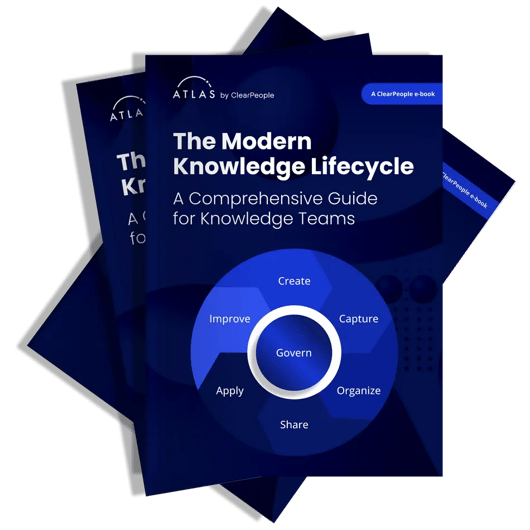
Knowledge lifecycle governance ensures that important organizational knowledge remains accurate, relevant, and trustworthy throughout its useful life. Every critical knowledge asset should have an identifiable owner and a lifecycle covering creation, review, publication, maintenance, and retirement.
One of the quietest KM failures happens after publication. Someone writes a brilliant guide. It gets reviewed, uploaded, and shared. Everyone moves on. Two years later, it still ranks highly in search. The author has left. The process has changed. Nobody knows whether the document remains valid.
Now add AI. The cost of stale knowledge is no longer limited to an employee finding the wrong page. AI can retrieve old information and reproduce it quickly and convincingly.
A simple lifecycle might look like:
Create → Review → Approve → Publish → Discover → Use → Review → Update or Retire
Ownership matters at every stage. For high-value knowledge, define who is responsible for accuracy, how often it should be reviewed and what happens when the review date expires. A knowledge base that only grows eventually becomes a knowledge landfill.
A modern knowledge layer connects information from existing systems and adds context, relationships, metadata and governance without requiring every source document to be moved into a single repository. This is becoming one of the more important architectural ideas in enterprise KM. Knowledge is rarely neat. It might live across:
The instinctive response used to be migration: move everything somewhere better. Sometimes that's necessary. But moving five silos into a sixth silo isn't necessarily knowledge management. A knowledge-layer approach asks a different question:
How can we connect the right information, context, expertise and governance while allowing appropriate systems to remain systems of record?
That approach can make knowledge available across search, Microsoft 365, Copilot and AI agents without forcing users to understand the underlying repository architecture.
Metadata is no longer just an administrative tool for organizing content. In an AI-enabled organization, metadata helps systems understand what information means, who it belongs to, when it applies and whether it can be trusted. This makes contextual enrichment increasingly important.
Useful metadata might include:
But there is a catch. If your metadata strategy depends on every busy employee filling in twelve fields every time they create a document, adoption will probably suffer. Automation matters. Organizations should look at where classification, tagging, entity recognition and metadata enrichment can happen automatically, while keeping human review for knowledge where judgment really matters. The goal isn't more metadata. It's better context with less friction.
By 2027, knowledge management should account for AI agents as active consumers, and potentially actors, within the enterprise knowledge environment. This is one of the biggest changes facing KM teams.
An employee retrieves information and decides what to do with it. An AI agent may retrieve information, interpret it and then initiate another action. That changes the risk profile.
Microsoft's current guidance already treats agent governance as an ongoing lifecycle covering deployment, data sources, access, sharing, security, measurement and eventual retirement. It also emphasizes controls for oversharing, sensitive information and compliance.
For KM leaders, this means asking new questions:
The further AI moves from answering to acting, the more important these questions become. Knowledge governance and AI governance are starting to converge.
AI can make information easier to discover and exploit accidentally, which makes permission hygiene a core knowledge management responsibility. If an employee has access to information they should not realistically need, an AI experience operating within that user's permissions may make the information substantially easier to surface.
Microsoft recommends organizations assess oversharing risks, apply protections to sensitive data and use appropriate security, compliance and lifecycle controls when deploying Copilot and agents.
Sometimes the best answer isn't a document, it's a person. Modern knowledge management should connect explicit knowledge, documents, guidance, policies, projects, with the expertise of the people behind it.
If someone finds a complex project report, can they identify who worked on it? If they search for a specialist topic, can they discover relevant experts as well as files? If an AI assistant provides an answer in a high-judgment domain, can it point the employee toward somebody qualified to help?
Expertise signals can include:
This creates a richer enterprise knowledge graph: not simply content about things, but relationships between people, work and knowledge.
Good knowledge management reduces the distance between an employee's question and the trusted knowledge needed to answer it.
For years, KM often asked users to go somewhere else. Open the intranet. Search the knowledge base. Navigate the document library. Check the wiki. Every extra step creates friction.
By 2027, the stronger model is increasingly contextual. Knowledge should surface where people already work: Microsoft Teams, SharePoint, Outlook, search, Copilot, business applications and AI agents. That might mean recommending related knowledge based on a project, surfacing guidance while someone completes a task, or allowing an employee to ask a natural-language question without knowing which repository contains the answer. The repository becomes less visible, the knowledge becomes more useful.
A knowledge platform containing 500,000 documents isn't necessarily better than one containing 5,000 genuinely useful assets. Measure outcomes closer to the business problem.
|
Old KM metric |
Better 2027 measure |
|
Number of documents |
Percentage of critical knowledge with an owner |
|
Search volume |
Successful answer/find rate |
|
Page views |
Knowledge reuse |
|
Number of contributors |
Useful, approved contributions |
|
Repository size |
Authoritative knowledge coverage |
|
Content growth |
Content freshness and retirement rate |
|
Active users |
Time saved / workflow improvement |
Organizations should measure not only whether employees use Copilot or agents, but whether the underlying knowledge produces accurate, useful and appropriately grounded outcomes.
The biggest KM mistakes in 2027 will be treating AI as a substitute for knowledge management, connecting AI to poorly governed content, creating another repository, ignoring knowledge ownership and measuring adoption without measuring answer quality or business impact.
Watch particularly for these traps:
“AI will solve search.”
AI can improve discovery dramatically. It cannot magically decide which contradictory policy is authoritative if the organization itself hasn't decided.
“Let's connect everything.”
More accessible information isn't automatically better knowledge.
“We'll clean the data later.”
AI makes information quality problems visible faster, not less relevant.
“Everyone owns knowledge.”
When everybody owns something, nobody usually maintains it.
“AI adoption equals AI success.”
A heavily used agent producing mediocre answers isn't a KM success story.
The first step in improving knowledge management is to identify a high-value business problem and understand the knowledge needed to solve it. Rather than attempting an enterprise-wide transformation at once, organizations should start with one important knowledge journey.
Map where the knowledge comes from, who owns it, how people find it, what makes it trustworthy, and where AI could safely improve the experience.
A strong 2027 KM strategy should prioritize trusted knowledge, connected architecture, lifecycle governance, AI readiness, secure access, expertise discovery, and measurable business outcomes.
Use this checklist when reviewing your strategy:
☐ We know which business problems KM is expected to improve.
☐ Critical knowledge has an identifiable owner.
☐ Authoritative content can be distinguished from general information.
☐ High-value knowledge has review and retirement rules.
☐ Employees can discover knowledge across important repositories.
☐ Metadata provides useful business context.
☐ Metadata enrichment is automated where practical.
☐ Permissions reflect genuine business needs.
☐ Stale and redundant knowledge is routinely addressed.
☐ Search connects content, context and expertise.
☐ Employees can access knowledge in their normal flow of work.
☐ AI answers can be traced to appropriate sources.
☐ Copilot and AI agents use governed knowledge sources.
☐ Agents have owners, approved data sources and lifecycle controls.
☐ Tacit knowledge has a deliberate capture strategy.
☐ KM performance is measured through business outcomes.
AtlasFuse is an intelligent knowledge platform built on Microsoft 365 that helps organizations implement modern knowledge management practices through connected knowledge infrastructure, enterprise search, metadata, governance, and AI-ready knowledge.
Rather than requiring organizations to move all their content into another repository, AtlasFuse creates a connected knowledge layer across Microsoft 365 and other enterprise systems. This helps transform fragmented information into trusted, contextualized, and reusable knowledge.
AtlasFuse supports modern knowledge management strategies by helping organizations:
For organizations investing heavily in Microsoft 365 and AI, the distinction is increasingly important. The objective isn't another place for employees to put documents. It's a better way for people, and now AI, to understand and use what the organization already knows.
For years, organizations could tolerate a surprising amount of mess in their knowledge environments. Employees compensated for it. They knew who to ask. They bookmarked useful pages. They remembered which folder contained the good template. They learned not to trust certain search results.
AI removes some of that friction. It also removes some of those human warning signs. An AI agent doesn't have ten years of organizational memory telling it that Policy-FINAL-v7-OLD.docx isn't actually the policy anyone follows anymore. That's why the next generation of knowledge management is less about accumulating information and more about establishing trust, context and authority at scale. The organizations that do this well will give employees better answers. More importantly, they'll give their AI better knowledge to work with. And by 2027, those may increasingly be the same problem.
Knowledge management best practices are the processes and methods organizations use to capture, organize, govern, share, and reuse knowledge effectively. They include assigning ownership, maintaining authoritative content, improving metadata and search, capturing expertise, managing the knowledge lifecycle, and measuring business outcomes. Modern KM also prepares trusted knowledge for AI assistants and agents.
The key principles of knowledge management are capturing valuable knowledge, providing context, establishing ownership, enabling discovery and reuse, and keeping information accurate and current. Effective KM also depends on collaboration, clear governance, appropriate permissions, and continuous improvement. These principles help organizations make knowledge useful for employees, business processes, and AI systems.
Organizations can improve knowledge management in 2027 by identifying high-value business use cases, connecting fragmented information, assigning knowledge owners, automating metadata enrichment, strengthening governance, and preparing authoritative knowledge for AI. A practical approach starts with one important knowledge journey, measures its effectiveness, and expands successful practices across the organization.
Knowledge governance defines how organizational knowledge is owned, classified, approved, accessed, maintained, and retired. It establishes accountability for knowledge quality and helps distinguish authoritative information from outdated or unverified content. In AI-enabled organizations, governance also helps determine which knowledge sources Copilot, AI assistants, and agents can safely access and use.
AI changes knowledge management by making organizational information accessible through conversational search, automated retrieval, and intelligent agents. This increases the importance of accurate metadata, authoritative sources, lifecycle management, permissions, and provenance. Organizations must govern not only how employees access knowledge, but also how AI systems retrieve, interpret, and potentially act on it.
Organizational knowledge should be reviewed according to its business importance, rate of change, and associated risk. Regulatory policies and operational procedures may require frequent reviews, while stable reference materials may need less attention. High-value knowledge should have a designated owner, a review schedule, and clear rules for updating or retiring outdated content.
Knowledge management requires shared responsibility with clear accountability. KM leaders establish strategy, architecture, and governance standards, while subject-matter experts own the accuracy of knowledge in their domains. IT, security, compliance, and AI governance teams support permissions, technical infrastructure, and responsible AI use. Executive sponsorship helps align KM initiatives with business priorities.
Subscribe to our newsletter
This site is protected by reCAPTCHA and the Google Privacy Policy and Terms of Service apply.
This site is protected by reCAPTCHA and the Google Privacy Policy and Terms of Service apply.